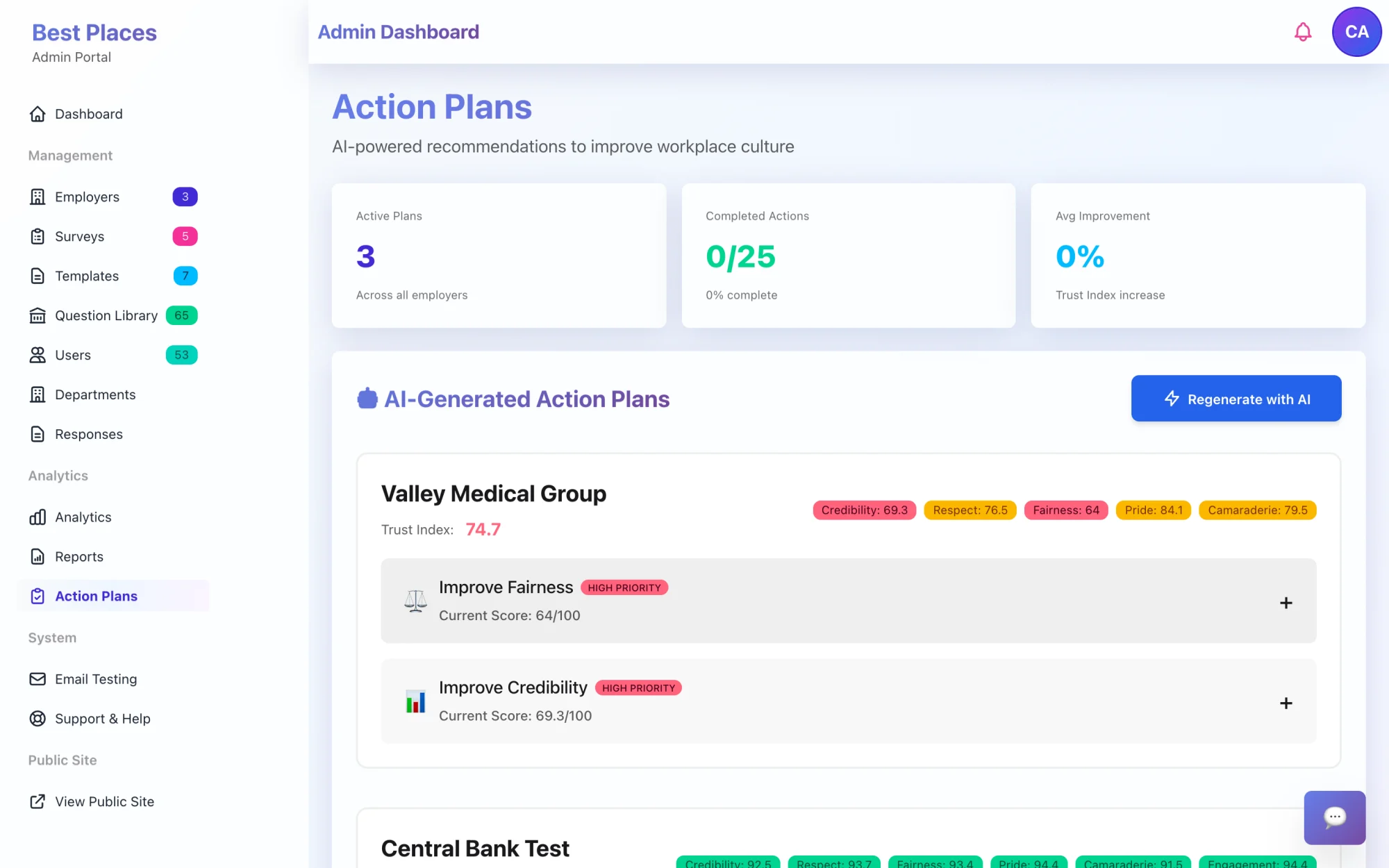
The multiple-choice questions on a survey give you scores. The open-ended comment box gives you the truth. That's where an employee types the sentence that explains everything — and it's exactly the part most survey tools quietly abandon, because reading a few hundred free-text comments is nobody's idea of a good afternoon. Here's how Chamber Culture turns that pile of raw feedback into a prioritized 90-day plan a manager can actually run.
Comments are the signal — and the bottleneck
Picture a 60-person company. A single survey cycle can produce a few hundred written comments — some one-liners, some paragraphs, most of them the real story behind the numbers. Read manually, that's hours of work, it's emotionally loaded, and whoever reads it brings their own bias to what "counts." So in practice, at most businesses, the comment box gets skimmed once and forgotten. The most valuable data in the whole survey goes to waste.
That's the problem the AI layer exists to solve — not to replace human judgment, but to make the reading tractable so judgment has something to work with.
What the AI actually does
When a survey closes, an AI pass reads every comment and does three unglamorous but essential things:
- Sentiment — it gauges the emotional weight of each comment, so a quietly furious paragraph doesn't get counted the same as a mild "could be better."
- Themes — it clusters hundreds of individual comments into the handful of issues actually driving them: scheduling, a specific manager dynamic, pay compression, tooling, whatever is really going on.
- Priority — it weighs each theme by how many people it touches and how strongly they feel, so you work on the thing that matters most, not the thing that shouted loudest.
Then it writes a plain-language action plan: the top themes, why they matter, and concrete next steps a manager can take this quarter. Not a word cloud. Not a dashboard that makes you do the interpreting. An actual plan.

The goal is never "more analytics." It's less: fewer, clearer priorities that a non-HR business owner can act on before the next cycle.
The anonymity guardrail
Reading every comment sounds like it should be in tension with privacy. It isn't, because of a hard rule: the AI works with the content of comments, never with who wrote them. Comments arrive stripped of identity, and the platform is architected so an individual's words can't be traced back to them. We take this seriously enough that it constrains the product — we've turned down features that would have made analysis richer but respondents more identifiable. (More on exactly how in Anonymous by Design.)
Why this changes the economics
The reason enterprise culture platforms cost what they cost is partly that someone — a consultant, an internal people-analytics team — is doing this interpretation by hand. Automating the reading is what makes a serious culture program viable for a 30-person business that will never hire a people-analytics team. It's a big part of how the platform delivers something genuinely useful at roughly 70% less than the enterprise incumbents.
Scores tell a member that something is wrong. The comments, read well, tell them what — and the action plan tells them what to do about it. That last step is the one that turns a survey from a report card into a tool.


