"On a scale of 1 to 10, how happy are you at work?" is the kind of question that produces a number and nothing else. It can't tell a business owner what to fix, and it can't tell them whether an 8 is good or a quiet warning. A culture survey is only useful if it measures the right things and turns them into something a non-HR person can act on. Here's the five-part model underneath the Chamber Culture Index — and why each piece earns its place.
One score is a headline, not an answer
Most engagement tools collapse everything into a single "engagement score." It's great for a slide and useless for a Monday. If the number drops three points, what changed? Pay? The manager? Burnout? Nobody knows, so nothing happens.
We break culture into five dimensions, each measured on its own, then roll them up into one headline number — the Chamber Culture Index — so you get both the summary and the diagnosis. On the Index, a dimension mean of 1 maps to 20 and a 5 maps to 100, so every score sits on a familiar 0–100 scale that's easy to compare across teams and over time.

The five dimensions
The Index is built on the proven Trust Index framework — the same five-part model the best workplace-culture research has used for decades. Each dimension answers a different, concrete question an employee can actually feel day to day:
- Credibility — Do people trust management's communication, competence, and integrity? Does leadership walk the talk? This is the foundation; when it's low, everything else is fragile.
- Respect — Do employees feel supported, included in decisions, and valued as individuals — not just as headcount? This covers development, collaboration, and being acknowledged for good work.
- Fairness — Is there equity in pay, recognition, and opportunity? Are the processes impartial? Perceived unfairness poisons a culture faster than almost anything else.
- Pride — Are people proud of their own work, their team, and the organization they represent? Pride is what turns an employee into an advocate.
- Camaraderie — Is there genuine community here — real relationships, a welcoming environment, a sense of belonging? This is the difference between a job and a place someone defends to their friends.
Score them separately and the story writes itself. A business can post a perfectly respectable overall Index while Fairness quietly sits ten points below everything else — which is exactly where their next resignation is hiding. One number would have buried that. Five surface it.
A number needs a "compared to what"
Even five good scores are only half the picture. Is a 74 on Communication for a regional manufacturer good or bad? On its own, unanswerable. That's why every dimension is shown against real benchmarks — national industry data from the Bureau of Labor Statistics and regional context from the U.S. Census — so a member sees not just their score but their score relative to businesses like theirs. We wrote a whole post on why those benchmarks matter.
Consistently strong scores earn a Best Workplace certification — Silver, Gold, or Platinum on the Chamber Culture Index. It's a real bar, cleared with real employee feedback, not a badge you can buy.
Built for a business owner, not an analyst
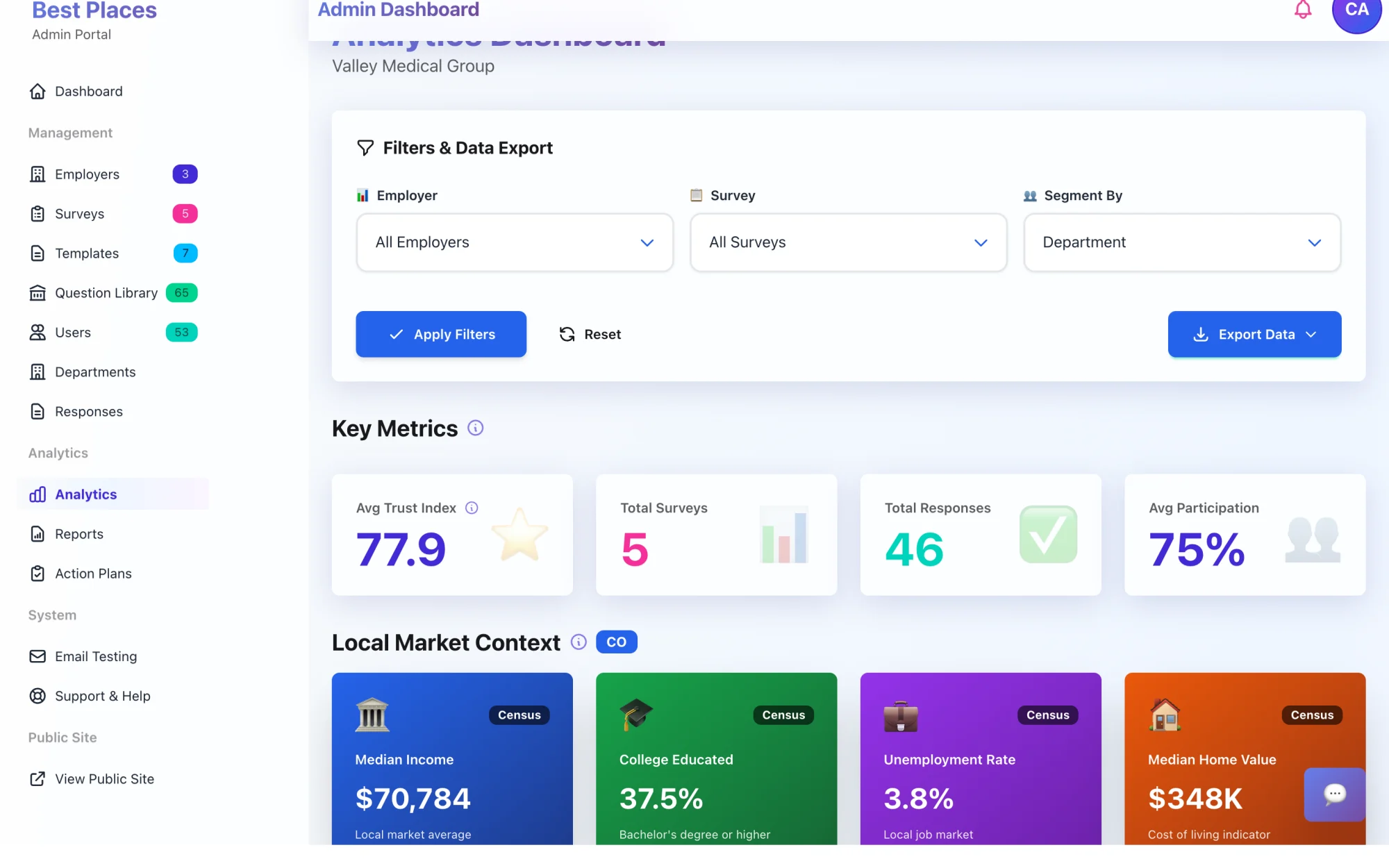
The point of the five-dimension model isn't academic tidiness. It's that a busy owner can open the dashboard, see one dimension trailing the others, read the AI's plain-language summary of why, and know where to spend their attention next quarter — without a consultant, a data team, or a statistics degree.
That's the whole design philosophy: measure honestly, benchmark fairly, and hand back something a normal manager can act on. If you want to see how the scoring works end to end, the methodology page lays it out — or you can just click through the live dashboard and watch the dimensions light up with sample data.


